Manufacturing Engineers: Choose CNC vs Conventional Milling to Save 20% and Boost Quality
Small manufacturers and startups often face a critical dilemma at a project’s inception: whether to invest in highly automated but initially expensive CNC milling or to stick with flexible but skill-dependent conventional milling. Making the wrong choice can lead to budget overruns, missed deadlines, or part quality that fails to meet the stringent standards of industries like automotive or aerospace. This challenge stems from a fundamental misunderstanding of each technology’s core capabilities, long-term Total Cost of Ownership (TCO), and their applicability across different production scenarios, from prototyping to batch manufacturing. A simple “which is better” comparison fails to provide actionable guidance for decision-making.
This article moves beyond basic comparisons to deliver a structured decision-making framework. We will dissect the fundamental differences between CNC and conventional milling, analyzing their impact on precision, complexity, surface finish, and cost-efficiency. By integrating technical principles with industry data, we aim to equip you with the insights needed to select the optimal process for your specific commercial goals and technical requirements. To make this critical choice effectively, we must first systematically compare the two technologies across their core dimensions.
How Do Control Systems Fundamentally Dictate Precision and Repeatability?
The core differentiator is the control system, which governs repeatability and quality. Conventional milling is an “experience-driven” manual process prone to human error, making consistent precision challenging. Conversely, CNC milling uses a predictable, automated digital program (G-code). It employs a closed-loop feedback system to make micro-corrections, ensuring micron-level repeatability, which is the foundation for stable batch production and “first-time-right” quality.
- The Human Element in Conventional Machining: In conventional milling, the operator is the control system. Setting the correct spindle speed, manually adjusting the feed rate, and positioning the workpiece all rely on the technician’s training and feel. While a skilled machinist can produce excellent work, this expertise is difficult to scale and is subject to natural variance. Achieving and holding a tolerance of ±0.05mm consistently for ten identical parts requires exceptional. Sustained concentration, making it an inefficient and unreliable method for volume production.
- The Digital Blueprint of CNC Precision: CNC precision is encoded before the first cut is made. The process begins with Computer-Aided Manufacturing (CAM) software, which translates a 3D CAD model into a precise toolpath. This digital blueprint dictates every move — the exact coordinates, spindle speed, feed rate, and depth of cut. The machine’s computer and servo systems then execute these instructions with unwavering accuracy and repeatability, completely decoupling final part quality from operator variability during the machining cycle itself.
- Quantifying the Consistency Advantage: The impact of this consistency is measurable in scrap rate reduction and quality compliance. For a part requiring a ±0.025mm tolerance, a conventional process might have a scrap or rework rate of 10-15% due to accumulated errors. A CNC process, once dialed in, can maintain a scrap rate below 2%. Over a production run of 1,000 parts, this difference translates to nearly 100 more good parts from the CNC process, representing massive savings in material, labor, and time, while ensuring every component meets the exacting demands of high-stakes industries.
Which Method Truly Unlocks the Potential for Complex Part Geometries?
The capability gap widens dramatically with complex geometries. Conventional milling, limited to basic shapes, requires multiple manual setups, introducing alignment errors. In contrast, CNC milling, especially 4-axis or 5-axis systems, breaks these limits. It enables simultaneous multi-axis movement, allowing intricate, organic shapes to be machined in a single setup with high precision. This makes it the only viable method for producing complex parts like impellers or medical implants.
The Setup and Error Accumulation Bottleneck
When facing a part with features on five sides, a conventional mill requires at least five separate setups. Each repositioning of the workpiece on the machine table introduces a new potential for human error in fixturing and alignment. The tolerance of each feature is now relative to a different setup, making it extremely difficult to maintain the geometric relationships and tight tolerances specified on an engineering drawing. This process is not only time-consuming but also jeopardizes the part’s functional integrity and fit.
2. Single-Setup Machining and Design Freedom
A 5-axis CNC machine can orient the part programmatically, allowing the tool to access all necessary features without removing the workpiece. This single-setup machining ensures that all geometric relationships are maintained from a single, consistent datum. This capability is a game-changer, as it eliminates setup errors and unlocks unprecedented design for manufacturability (DFM) freedom. Engineers are no longer constrained by machining accessibility and can design optimized, lightweight, consolidated parts that were previously impossible or prohibitively expensive to make.
3. Case in Point: From Impossible to Routine
Consider a titanium spinal fusion cage with a complex lattice structure designed to promote bone ingrowth. Machining this on a conventional mill is virtually impossible due to the intricate internal voids and thin struts. A 5-axis CNC machine, using specialized toolpaths and a small-diameter tool, can precisely mill this lattice in a single setup. This not only creates the part but does so with the high accuracy and surface finish required for a medical implant. Turning an engineering marvel into a manufacturable routine.
Why Does CNC Milling Consistently Deliver Superior Surface Finishes?
Surface finish is critical for both function and aesthetics. Conventional milling relies on manual control, which can lead to visible tool marks, chatter. And inconsistent roughness due to human variables. CNC milling, however, achieves superior and consistent finishes through programmatic control. The CAM software optimizes toolpaths to maintain constant cutting conditions, preventing vibration and ensuring uniform cutting forces. This precise, automated process often produces a high-quality finish directly, reducing the need for secondary polishing..
1. The Mechanics of Manual Inconsistency
In manual milling, achieving a fine finish requires the operator to make a final, light “spring pass.” The consistency of this pass depends entirely on the machinist’s touch and the machine’s mechanical backlash. Slight variations in hand pressure or tool deflection can lead to an uneven finish. When machining curved surfaces with a ball-nose end mill, maintaining a consistent step-over distance and feed rate by hand is exceptionally challenging, often resulting in a visibly scalloped or irregular surface texture.
2. Programmed Perfection in Toolpath Strategy
CNC software algorithms are design to maximize surface quality. For finishing operations, the software calculates a toolpath that ensures the step-over between passes is extremely uniform, creating a smooth, predictable surface pattern. It can also adjust the tool axis orientation relative to the surface (lead and tilt angles) to always use the most effective part of the cutting edge, a level of control impossible to achieve manually. This strategic toolpath planning is the key to achieving low Ra values directly from the mill.
3. The Cost Impact of Finishing Operations
A superior as-machined finish has direct cost implications. A part coming off a CNC machine with an Ra of 0.8 µm may require no further finishing. A conventionally milled part with an Ra of 3.2 µm will likely need manual polishing or grinding to meet specifications. This secondary finishing operation adds labor time, cost, and introduces another variable that can affect part dimensions. By delivering a better finish directly, CNC milling streamlines the process, reduces touch labor, and accelerates the overall production timeline, contributing directly to improved cost efficiency.
Can Conventional Milling Still Win in a Race Against the Clock for Urgent Orders?
A common misconception is that conventional milling is faster for quick-turn projects. While it may be advantageous for simple, one-off repairs, this benefit disappears when handling urgent orders requiring multiple parts or any complexity, as manual speed is limited by human stamina and the high risk of errors under pressure. In contrast, CNC milling, despite requiring upfront programming, automates the process. Once the program is verified, the machine can run unattended, producing parts with consistent cycle times. This high first-pass yield eliminates the hidden time costs of rework and scrap, making CNC a more reliable and often faster solution for delivering urgent multi-part orders.
The Myth of the “Quick” Manual Setup:
The apparent speed of manual setup is offset by its inherent limitations in replication. Each part in a batch requires the same manual measurements, edge-finding, and tool positioning to be repeated. For a batch of 20 parts, this means performing the same error-prone setup routine 20 times. In CNC machining, the setup — including locating the workpiece datum and tool offsets — is done precisely once with probes or edge finders. The program then repeats the process perfectly for every subsequent part, making batch production exponentially more efficient.
The Power of Unattended Production and Lights-Out Machining:
The true accelerator for urgent orders is the ability to leverage unattended production cycles. After the first part is inspected and approved, a CNC machine can be set to run a full batch overnight or over a weekend. This lights-out machining capability effectively multiplies available production hours without increasing labor costs. A conventional mill requires constant operator attention, limiting production to a single shift and making it impossible to leverage off-hours to compress delivery schedules for urgent needs.
Risk Mitigation in Time-Sensitive Projects:
For an urgent order, the greatest risk is missing the deadline due to a scrapped part that requires starting over. CNC machining mitigates this schedule risk through its digital consistency. The probability of a random error causing scrap after a program is proven is very low. In manual machining, the risk of a lapse in concentration or a mis-measurement is present with every operation on every part. The predictable, reliable output of CNC provides a more secure foundation for guaranteeing delivery dates on critical, time-sensitive projects.
Beyond the Machine Price Tag: What’s the Real Cost of CNC Milling?
The perception of CNC milling as more expensive is superficial. A true cost analysis must consider Total Cost of Ownership. While conventional milling has a lower initial cost, its per-part costs are higher and more variable due to reliance on skilled labor, greater material waste, and inconsistent outcomes. In contrast, CNC milling involves a higher initial capital and programming investment, but its economic advantages are compelling. Labor is redistributed (one programmer can manage multiple machines), material use is optimized, and scrap rates are drastically lower. For production runs beyond a few parts, CNC’s lower variable cost per part makes it far more cost-efficient at scale.
1. The Hidden Costs of the “Cheaper” Option
The true cost of conventional milling lies in its dependence on scarce skilled labor and variable output quality. Finding and retaining highly experienced machinists is costly and challenging. Furthermore, the scrap rate is inherently less predictable. A single costly mistake on a complex part can wipe out the perceived savings from lower hourly machine rates. The lack of process repeatability also makes accurate job costing and scheduling difficult, leading to budget and timeline overruns that are hard to quantify upfront but painfully real in execution.
2. The CNC Value Proposition: Predictability and Scalability
CNC machining converts manufacturing from a craft into a predictable engineering process. This predictability is its greatest economic asset. Costs can be accurately estimated based on machine time and material. Production schedules are reliable. Quality is consistent, reducing inspection time and warranty claims. This allows businesses to scale production with confidence, bid competitively with firm quotes, and build a reputation for reliability. The value shifts from the skill in the machinist’s hands to the intelligence in the program and the robustness of the production system.
3. Making the Business Case: A Simplified TCO Scenario
Consider a part with a annual volume of 500 units. Conventional milling might have a low machine rate but a high labor and scrap cost, yielding a cost per part of $120. CNC milling has higher machine overhead but lower variable costs, yielding a cost per part of $100. While the CNC machine is more expensive, the $20 savings per part amounts to $10,000 saved annually. Over a few years, the CNC investment pays for itself and then generates ongoing savings. This simplified model illustrates why for anything beyond the smallest volumes, CNC offers a superior return on investment and lower life-cycle cost.
What is the Practical Framework for Choosing Between and Conventional Milling?
The choice is not about finding a universal winner but about matching the right tool to the specific project. A clear, logical decision framework based on four key factors will guide you to the optimal, cost-effective solution. This framework evaluates your part’s needs against the core strengths of each technology, moving beyond gut feeling to a data-driven selection process. For a more detailed breakdown of the technical distinctions, a resource outlining the 7 key differences between CNC and conventional milling can provide deeper context.
1. Assess Part Complexity and Geometric Features
Start with a clear-eyed assessment of the part’s geometry. Is it a simple prismatic block with holes and pockets? A traditional 3-axis mill or even a manual machine might suffice. Does it have complex 3D contours, undercuts, or features on multiple sides? This immediately pushes the decision strongly toward 3+2 or 5-axis CNC machining. The need for a single setup to maintain accuracy across complex geometries is often the primary and decisive factor in choosing CNC technology.
2. Evaluate Production Volume and Demand Predictability
Volume is the great economic arbitrator. For one-off prototypes, repairs, or truly unique single pieces, the setup and programming cost of CNC may not be justified; conventional milling offers flexibility and lower upfront cost. However, once you move into low-volume production (e.g., 20-50 pieces) or have predictable recurring orders, the economics flip. The programming cost is amortized, and the consistency, speed, and unattended operation of CNC dramatically lower the per-part cost and improve delivery reliability.
3. Define Precision and Surface Finish Requirements
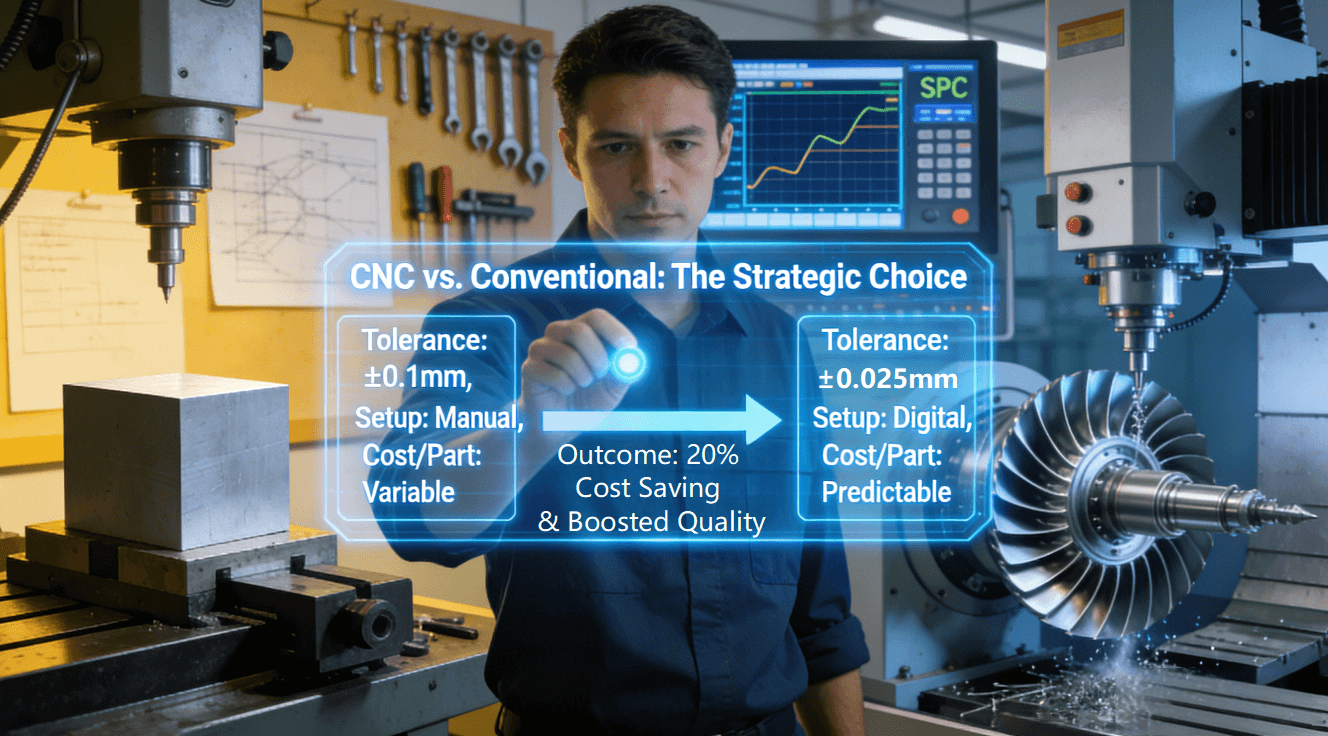
Examine the drawing tolerances and surface callouts. If tolerances are loose (e.g., ±0.5mm) and surface finish is not critical, conventional milling can meet the need. If the drawing calls for tight geometric tolerances (e.g., ±0.025mm), precise positional accuracy, or a fine surface finish (e.g., Ra 0.8 µm or better), CNC is the necessary choice. Its programmatic control is the only way to reliably and repeatedly achieve these specifications, which are essential for parts in assemblies, moving mechanisms, or regulated industries.
4. Analyze Internal Resources and Total Project Budget
Finally, consider your internal capabilities and the total project budget, not just the machining quote. Do you have in-house skilled manual machinists or CNC programmers? What is the true cost of a delayed delivery or a failed part? For many businesses, partnering with an expert Online Custom CNC Milling Service provider offers the perfect balance. It provides access to advanced CNC capabilities, proven processes, and volume-based pricing without the capital investment, allowing you to leverage CNC’s advantages precisely when and where you need them.
Conclusion
The decision between CNC and conventional milling is a strategic one that balances technical requirements with business objectives. Conventional milling retains value for its flexibility, low barrier to entry, and suitability for simple, one-off tasks. However, for the demands of modern manufacturing — high precision, complex geometries, consistent quality, and scalable efficiency — CNC milling provides a transformative advantage. By applying the structured framework of part complexity, volume, precision, and resources, manufacturing engineers and business leaders can move beyond guesswork. They can make informed, optimal choices that control costs, ensure quality, and leverage the right technology to build a competitive edge in an increasingly demanding market.
FAQs
Q: What materials can be processed with CNC milling that are challenging for conventional milling?
A: CNC’s program-controlled precision is crucial for difficult-to-machine materials like titanium alloys and hardened steels, preventing tool damage. While conventional methods can handle softer metals, CNC guarantees consistency for complex shapes in critical sectors like aerospace and medical, where material integrity is paramount.
Q: Is CNC milling cost-effective for a small batch of only 10-20 parts?
A: Cost-effectiveness depends on part complexity. For simple designs, CNC setup costs may dominate. However, for parts requiring high precision or complex features, CNC becomes economical even at low volumes by virtually eliminating scrap and rework, a key advantage offered by optimized online machining services.
Q: Doesn’t the programming time for CNC milling negate its speed advantages for quick-turn projects?
A: Modern CAM software minimizes programming time. The true speed advantage lies in unattended, consistent production once the program is proven. Furthermore, programs are saved and instantly reusable for future orders, making CNC faster for repeat batches and often competitive for quick-turn prototypes after the initial setup.
Q: How significant is the maintenance cost and downtime for CNC machines compared to conventional ones?
A: CNC requires scheduled, predictable preventative maintenance. Conventional machines have lower planned costs but higher risk of unplanned downtime from wear. Overall, CNC’s planned upkeep and higher reliability typically result in better overall equipment effectiveness (OEE) and more dependable production scheduling.
Q: What is the best achievable tolerance with standard CNC milling, and when is conventional milling’s tolerance sufficient?
A: Standard CNC milling reliably holds tolerances of ±0.025 mm (±0.001”) or better. Conventional milling, reliant on operator skill, typically achieves around ±0.1 mm. Therefore, CNC is necessary for tight fits and interchangeability, while conventional may suffice for simple parts with looser tolerances.
Author Bio
The insights presented in this article are courtesy of LS Manufacturing, a company dedicated to assisting engineers and product developers in navigating complex manufacturing decisions and transforming creative concepts into high-quality components. Backed by a commitment to excellence supported by certifications such as ISO 9001, IATF 16949, and AS9100D, they provide reliable solutions throughout the entire process — from prototyping to mass production. For expert DFM analysis and a customized quote, we invite you to explore their online custom CNC milling services and embark on your project journey.