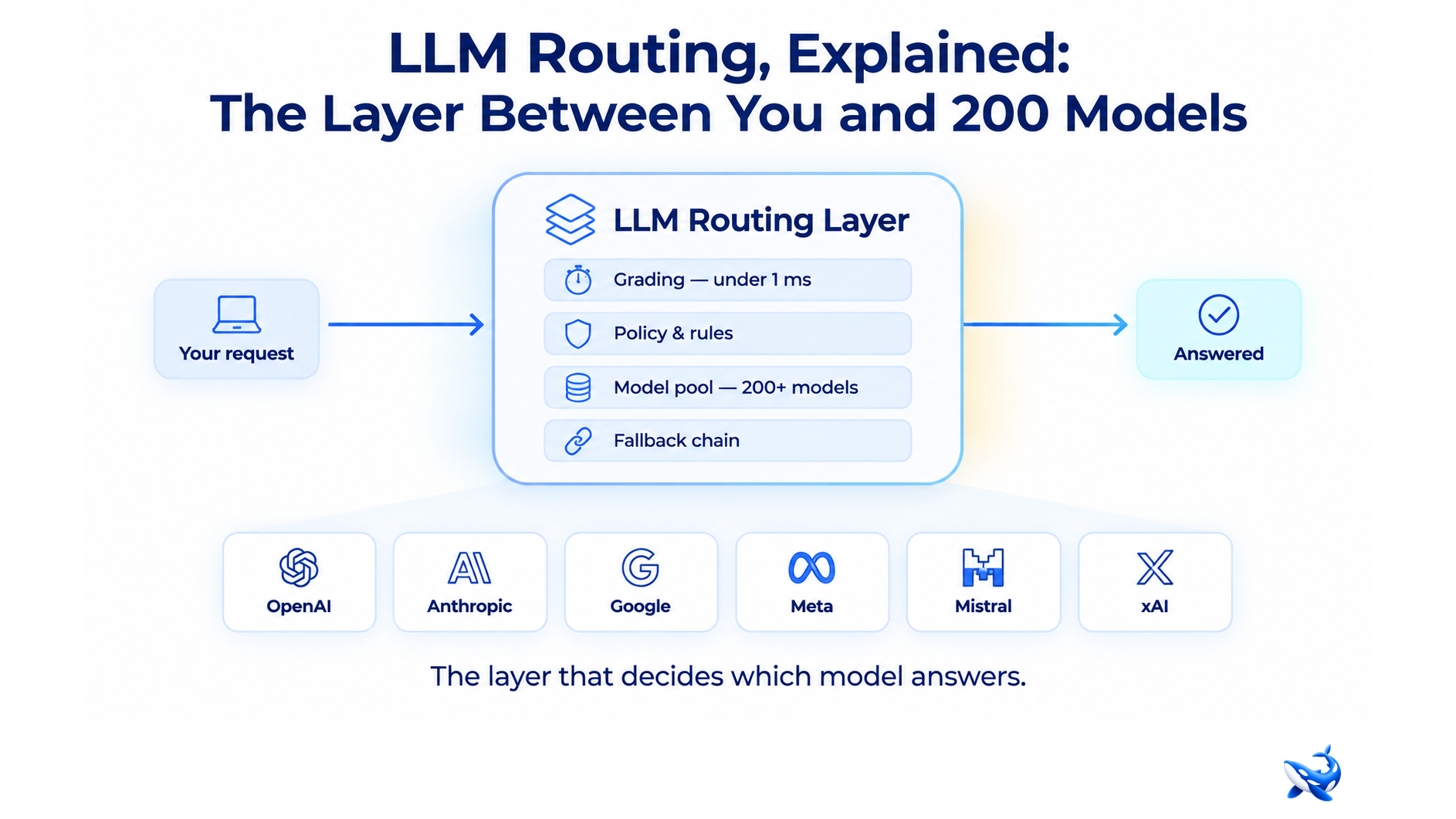
LLM Routing, Explained: The Layer Between You and 200 Models
llm router sits between your application and every model provider and decides which model answers each request. We’ve covered the routing layer in product terms, and the current rate card for Claude Sonnet 5 shows what the mid-tier actually costs per million tokens. This piece is the plain-English version of the machinery underneath the parts a router is built from. The inputs it weighs, and why a thin decision layer between you and 200+ models changes your costs, your failure rate, and your compliance story.
Choosing a model today is really choosing a single point of compromise. The cheapest model might hallucinate on your legal queries. The strongest model is overkill for a summarization job and bills like it. And the model you pick is a fixed commitment until someone edits code and redeploys. LLM routing exists because the compromise is a per-request decision, not a per-project one. A request about a bug fix wants different capabilities than a request that rewrites marketing copy — and the router is what makes that distinction automatic instead of manual.
What the routing layer is made of
Strip a router down and it has four parts.
A grading or classification step. Every prompt gets read before it gets routed. This step answers the only question the router really asks: what is this request, and how hard is it? Is it a coding question, a document summary, a translation, a classifier call? Does it need long-context reasoning, or will a small model do? In production systems this grading is deliberately cheap OrcaRouter reports that each prompt is graded in under 1 ms before routing [OrcaRouter], fast enough that the decision costs less than the network round trip that follows it.
A policy or rules engine. The grade is the input; policy is the judgment. Policy encodes the standards the router is allowed to drop below a minimum quality bar for this traffic. A maximum spend per request, a latency ceiling, a list of approved providers. You write the rules once (“support messages never go below this quality tier; batch jobs may use the cheapest model; never route finance data outside this region”), and the router applies them per request.
The model pool. The candidates. A routing layer only pays for itself when the pool has genuine spread — a frontier flagship for the hard requests, a mid-tier workhorse for the average ones, small and cheap models for volume. With one API key covering 200+ models across OpenAI, Anthropic, Google, Meta, Mistral, xAI, DeepSeek, Qwen, GLM and MiniMax [OrcaRouter], the pool is wide enough that the router can actually change its answer instead of just pretending to.
The fallback chain. The safety net. When the first-choice model errors out, rate-limits you, or times out, the router tries the next candidate in order instead of returning a 5xx. This is what turns a single model outage into a non-event.
What the router weighs before it decides
The grading step looks at a handful of inputs, and it’s worth naming them because they’re also the knobs you’ll tune:
• Difficulty. Estimated from the prompt itself — length, domain, ambiguity, reasoning depth. This is the core of the grade.
• Budget. Per-request spend limits and blended-cost targets. The router’s whole trick is finding the cheapest model that still clears your quality bar.
• Latency. Time-to-first-token and throughput budgets. A chat response that takes 40 seconds is a failed request no matter how smart the model was.
• Provider health. Real-time availability, error rates and load. A healthy provider beats a smarter one that’s currently failing.
• Context. Recent conversation state and prompt prefixes. A follow-up in a long session should continue on the same model (or one that can see the full history), not restart fresh on a different one — prefix-aware and session-aware routing handle exactly this [OrcaRouter].
Notice that none of these are qualities of the model in the abstract. They’re all qualities of this request, right now, against this pool. That’s the conceptual shift routing asks you to make: a model isn’t “the best,” it’s “best for this prompt at this price under these constraints.”
One routing decision, end to end
Let’s follow a single request. You run a support portal; a customer pastes a two-page crash log and asks what went wrong. The request enters the router.
The grading step reads it and classifies it as a technical diagnostic — high complexity, needs real reasoning. Policy says: technical diagnostics may not fall below the frontier tier, spend per request up to $0.02, first token in under 10 seconds, providers in the approved list. The router scans the pool, filters to models that clear the quality bar, then picks the cheapest one that still fits the budget and latency windows. The request is forward under your single API key, and the model streams back an answer.
Now the same customer sends a second message: “thanks, that fixed it.” The grader sees a courtesy message — low complexity. Policy lets it drop to the cheapest tier. The router picks a small, fast model and the reply costs a rounding error instead of a flagship inference.
And if that small model is temporarily rate-limited? The fallback chain silently promotes the request to the next candidate. The customer sees a fast, correct reply. You see a log entry showing the failed attempt and the retry. This is automatic failover in action [OrcaRouter] — and it’s the difference between a router and a glorified API wrapper.
What routing is not: caching, and SDK abstraction
Two things get conflated with routing, and the boundary matters.
Routing is not caching. A cache returns an identical answer for an identical question. A router returns a different answer from a different model every time the inputs change. Caching saves money when the same prompt repeats (shared system prompts, common prefixes). Routing saves money when different prompts get match to different models. They compose beautifully — you cache the repeats and route the rest but they’re solving different problems.
Routing is not SDK abstraction. An SDK that unifies a provider API is a translation layer: it lets you write client.chat() once and point it at different providers by changing a config string. That’s a convenience, not a decision. The router is what makes the decision per request, automatically, using live data. The difference shows up in the failure case: an SDK will happily send your expensive request to the overloaded provider and hand you the error. A router will have already picked the healthy provider and retried on failure.
| Routing | Caching | SDK abstraction | |
| Picks a model per request | Yes, automatically | No | No |
| Reuses prior answers | No | Yes | No |
| Changes vendor via config | Yes | N/A | Yes |
| Retries on provider failure | Yes | No | No |
| Lowers blended cost | Yes | Yes, for repeats | Indirectly |
What you actually get out of it
The operational payoff has four parts, and they compound.
One integration. One API key, one endpoint, 200+ models [OrcaRouter]. New providers and new model releases appear in the pool without a code change. Your application code stops being a map of provider credentials.
Lower blended cost. Because every request is steer to the cheapest model that satisfies the policy, the average price per request falls below the price of any single “default” model you would have hard-coded. The 0% markup model matters here: with vendor list prices passed through at 0% markup and glass-box receipts [OrcaRouter], you see exactly what each model charged, so you’re optimizing against real numbers rather than a blended mystery bill.
Fewer failures. Fallback chains and provider-health awareness mean a single provider’s outage degrades gracefully. The error budget moves from “some vendor is down, page is broken” to “some vendor is down, latency ticked up.”
Easier compliance. A router is a choke point, and a choke point is where audit lives. Request logs capture every call — model used, cost, who made it, timestamps [OrcaRouter] — which turns “prove this data went only to approved providers” from an archaeology project into a query.
The takeaway
LLM routing is for teams that have outgrown “one model, set in stone”: you’re running several workloads with different quality, latency and cost requirements, and you’d rather let policy make the per-request call than write per-model code paths. It’s not for a single-POC project that calls one model and never changes it — there, routing is overhead. And it isn’t a substitute for a good model, a good prompt, or a good cache; it’s the layer that stops those decisions from being bake into your code.
The decision rule that actually matters: if the right model for a request depends on the request itself, you already need a router. Start with the cheapest honest test — one router, a 0% markup price pass-through so the bill reflects real list prices, automatic failover so the experiment doesn’t break prod — and measure whether blended cost and failure rate move. If they do, the layer stays.
Sourcing note: all OrcaRouter product facts (one API key for 200+ models, prompts graded in under 1 ms, 0% markup with vendor list prices passed through, automatic failover, prefix-aware and session-aware routing, request logs, model catalog) are taken from OrcaRouter’s own homepage and product pages — https://www.orcarouter.ai, /solutions/adaptive-routing, and /models — checked August 22, 2026. Model vendors listed (OpenAI, Anthropic, Google, Meta, Mistral, xAI, DeepSeek, Qwen, GLM, MiniMax) are from the same catalog. No third-party benchmarks were cited in this piece.